
A chart is circulating on social media: in Cambodia, in Rwanda and among Jews during the Holocaust the population fell, in Gaza it grew, so there can be no genocide there. But the Genocide Convention does not ask about population size, the curve did not fall for the Yazidis, the Rohingya or the Ixil, and the chart's figures for Gaza are a pre-war projection. According to Palestinian statisticians, the population of Gaza has fallen. We explain what defines genocide and where the dispute over Gaza really stands.
10/30/2026


Thirty-two per cent of Czechs believe that a woman who was drunk is at least partly to blame for sexual violence, twice the European Union average. We took the statements from a bingo card circulating on social media and set them against data, research and the law.
10/21/2026

Where society is least resilient to disinformation according to the Media Literacy Index 2026, people hold the most favourable view of Russia according to Eurobarometer. Two thirds of Czechs support sanctions against Russia, but fewer than a third support weapons for Ukraine. In Slovakia, roughly half of people adopt the Kremlin's account of the war, yet only a fifth to a quarter want to leave the European Union and NATO.
9/28/2026

Fathers of children under six are in paid work more often in Czechia than anywhere else in the European Union; mothers, together with those in Romania, least often. The 46-percentage-point gap is unmatched in the EU. Mothers do want to work: once their child starts school, Czech women are employed more often than anywhere else in Europe. At a round table in the Chamber of Deputies, experts agreed that what keeps them out of the labour market is a lack of nurseries, a lack of part-time jobs and fathers who do not take parental leave. From January 2027, the government is raising the parental allowance to CZK 400,000.
9/23/2026

The government promises cheaper fuel. But for most people who fill up with gasoline at regular pumps, almost nothing will change. The tax on gasoline remains the same, and most stations already kept margins low before regulation. The intervention can help significantly mainly at expensive highway pumps.
4/4/2026


More than a third of coalition lawmakers lead some non-profit organization. But most of these organizations don't even publish the most basic financial data.
3/18/2026

Detailed analysis of voter shifts.
10/9/2025

Election results will be known a few dozen minutes after polling stations close. Prediction models enable accurate estimates already at about 1.5% of counted votes.
10/4/2025

In the financial declarations of Czech MEP Filip Turek, we have uncovered major discrepancies that raise fundamental questions: where do his declared incomes actually come from, and why do his claims and financial statements completely contradict each other?
5/20/2025
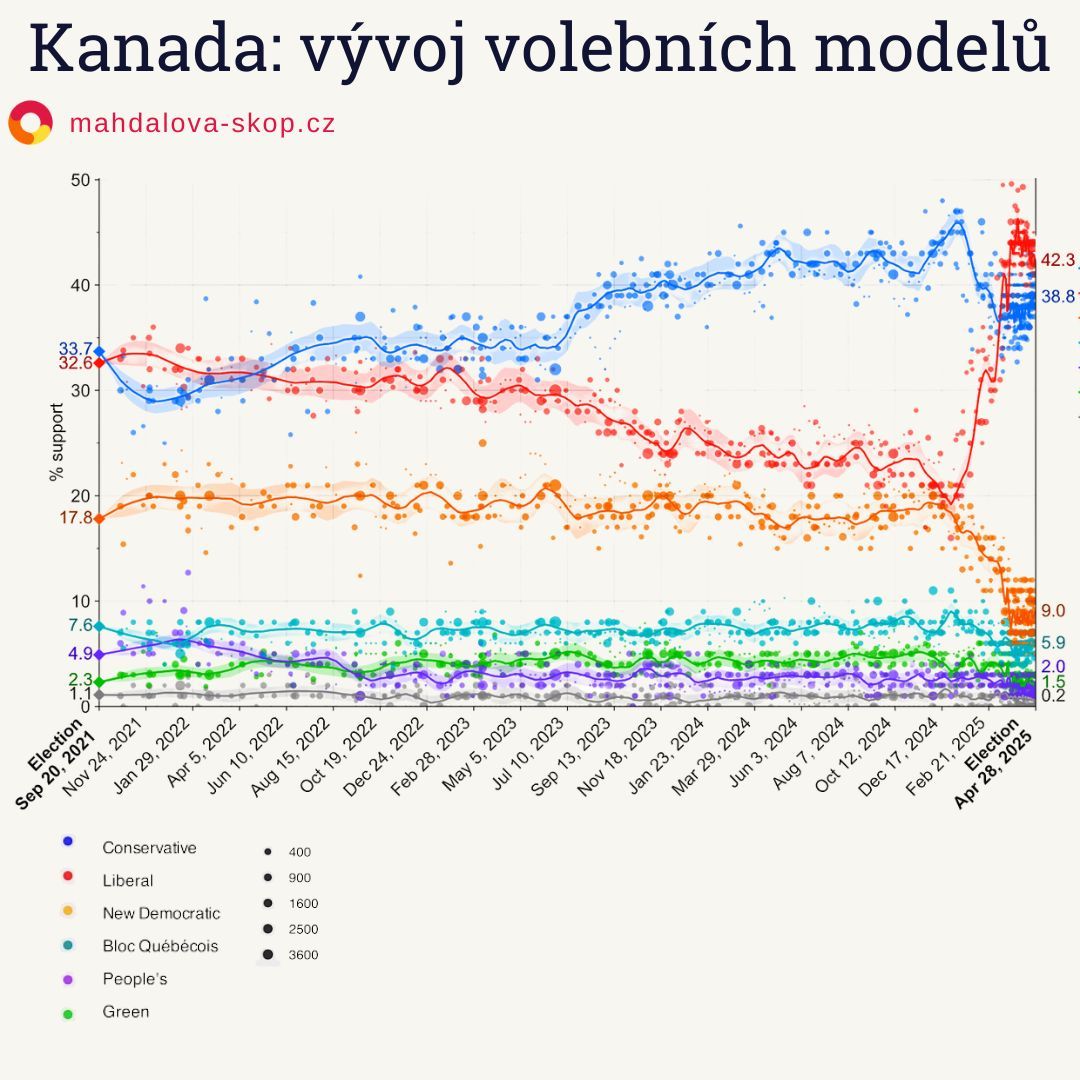
At the beginning of 2025, it looked clear. Justin Trudeau was written off, the Liberal party was losing by over 20 points in polls, and the Conservatives were heading for a comfortable victory. And then Trump arrived.
4/29/2025

The German parliamentary elections were held on Sunday. At first glance, it may seem that former East Germany has become radicalized, but this is quite a distorted view.
2/28/2025

The German parliamentary elections will take place on Sunday. Why traditional election maps are not always the best choice and how to interpret the results correctly.
2/21/2025

European Parliament 2024.
12/19/2024

Our cartograms have been selected as exemplary by the official Statistik Austria.
11/27/2024

We identified errors in counting electoral votes in several polling stations.
7/8/2024