Germany has a bicameral parliament. The lower house is called the Bundestag, and the upper house is the Bundesrat.
The Bundestag will be directly elected by citizens this Sunday, while the Bundesrat consists of representatives from individual federal states.
Each voter has two votes: the first vote is for a direct candidate in their electoral district. There are 299 districts, each covering about ¼ million voters.
The second vote is for a party and determines how many seats each party will have. A total of 630 seats are up for election.
Parties that receive more than 5% of the vote or win at least three districts directly gain representation in the Bundestag.
But let's look at the map.
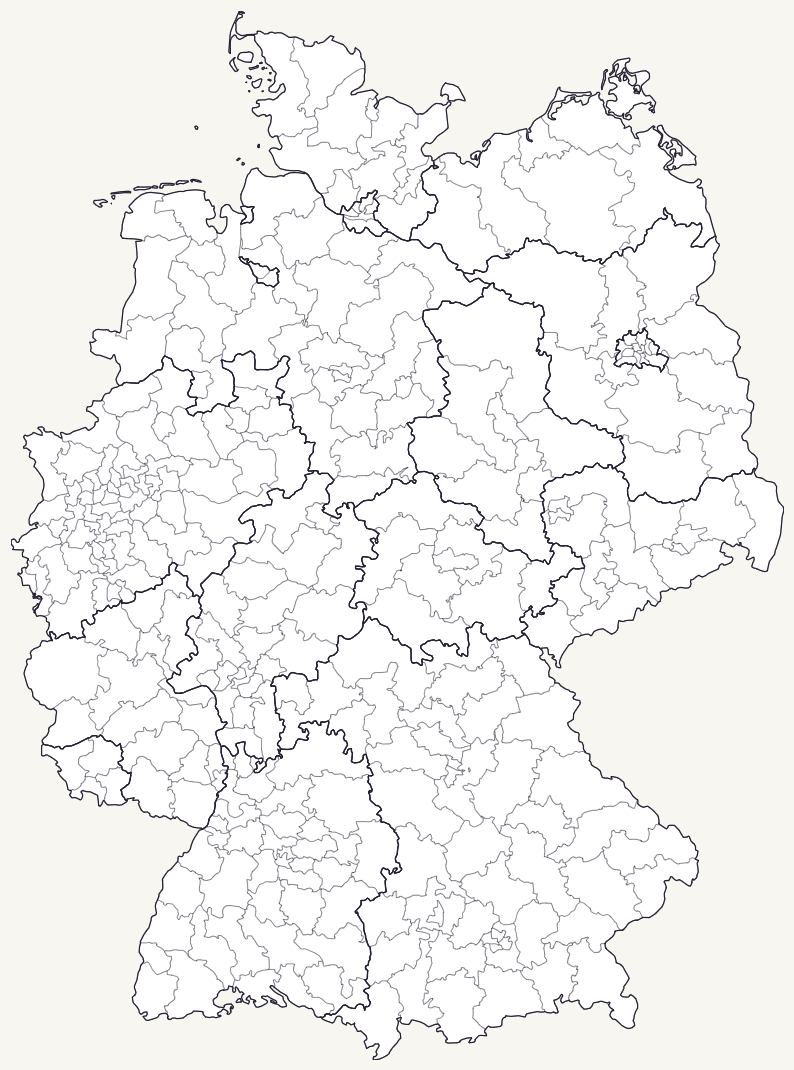
The first vote means that 299 MPs are elected directly in single-member districts. Each district appears differently sized on the map, but they all have roughly the same number of voters.
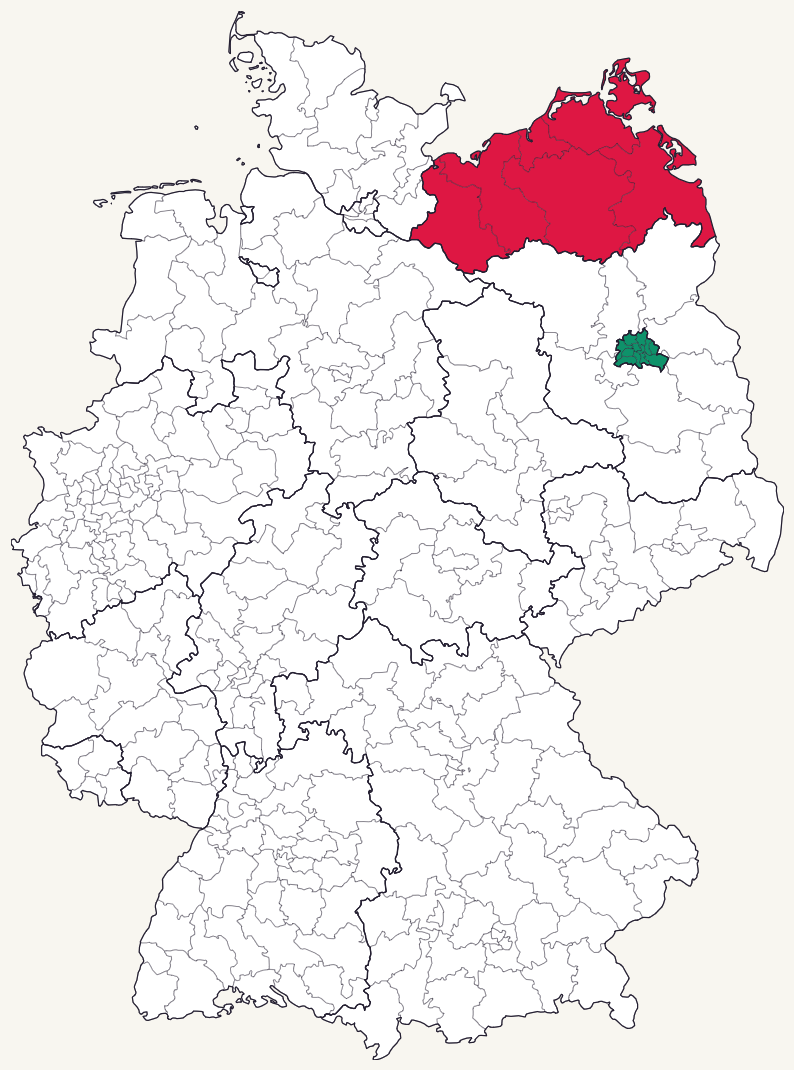
And here's the main problem with this map: The size of a district on the map does not reflect the number of voters living there. Take a look at the Baltic federal state Mecklenburg-Vorpommern and Berlin.
Berlin appears significantly smaller on the map, but it has twice as many districts and roughly twice as many voters.
This becomes even more apparent when we compare two selected districts from these regions.
The district of Mecklenburgische Seenplatte II elects one MP, just like the almost invisible Berlin-Mitte on the map!
Fair representation for electoral districts!
To solve this issue, we transform the map into a cartogram. Each electoral district, whether it is the vast Mecklenburgische Seenplatte II or the city-center district of Berlin-Mitte, is given the same size and shape as a hexagon.
This is the ultimate fair representation!
But let's go back to the traditional map.
The polling agency YouGov has published predictions based on its surveys about who has the highest chance of winning in each district.
The standard map mostly shows black CDU/CSU and a large patch of light blue AfD in eastern Germany.
The entire former East Germany, except for Berlin, is a stronghold of AfD, has 48 districts.
Meanwhile, the largest federal state in the west, North Rhine-Westphalia, has 64 districts.
The cartogram reveals the true strength of votes in both regions.
The cartogram provides a clearer picture of the actual impact of votes.
As the saying goes, "land does not vote, people do.” The physical size of an area does not matter; voters decide.
According to polls, the Christian Democratic CDU/CSU is expected to receive the most votes, with AfD in second place, the Social Democratic SPD third, and the Greens fourth.
The left-wing Die Linke also has a fair chance. The Sahra Wagenknecht Alliance and FDP are hovering around 5%.
This is the final electoral model for individual districts, according to YouGov, before the elections.
 The results of the German elections will impact all of Europe. We will be monitoring and analyzing them.