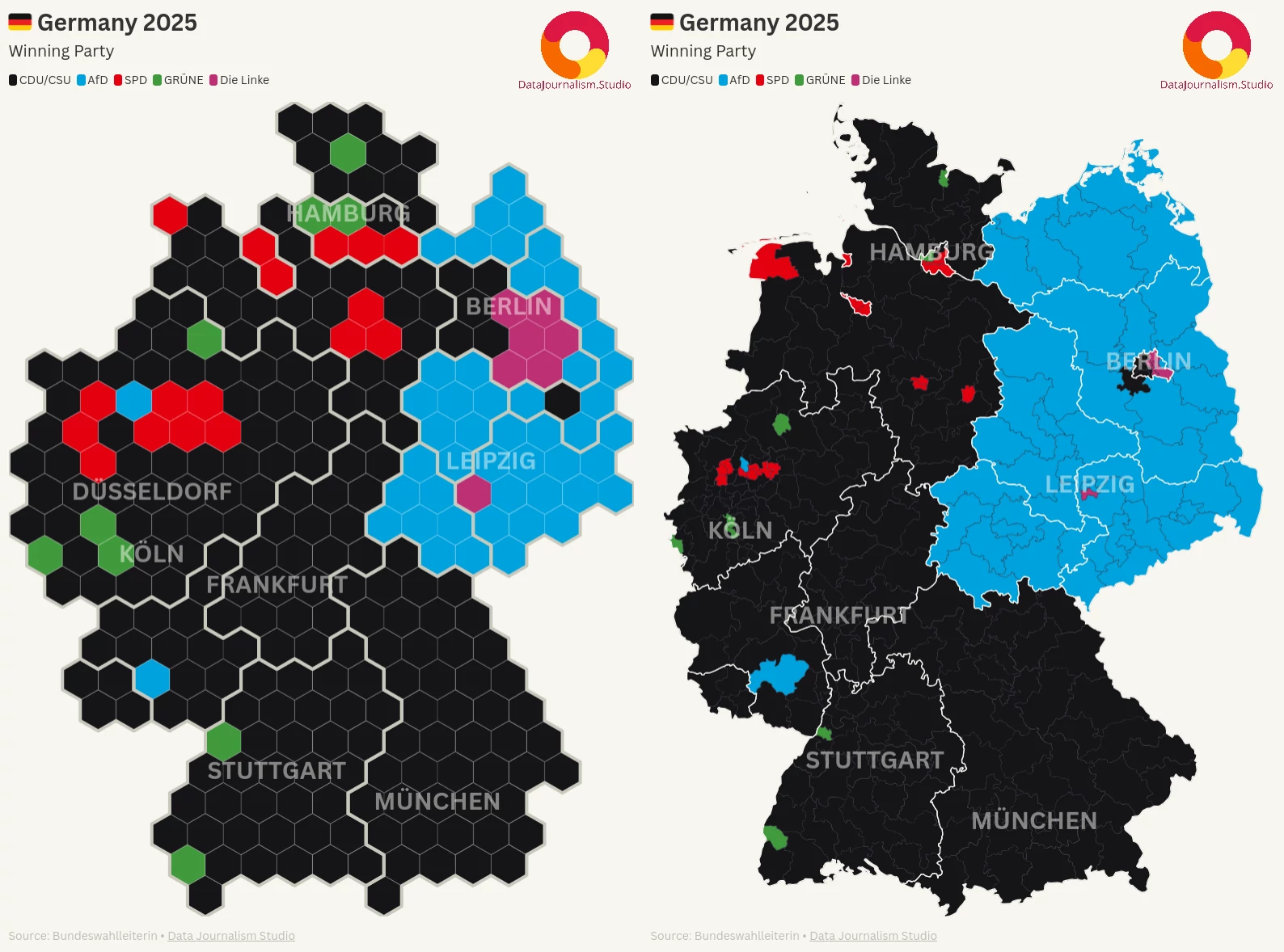
In the election to Berlin's state parliament on 20 September, almost half of voters under thirty, 47%, backed the Left Party (Die Linke). Among Berliners over sixty, 13% voted for it. That is the finding of a survey by Forschungsgruppe Wahlen for the ZDF television channel, which questioned 17,460 people on election day. According to the preliminary official result, the party won 25.7% of the vote overall, 13.4 percentage points more than in the 2023 repeat election, and for the first time in the history of Berlin state elections it came first. The CDU was second with 18.8% and the AfD third with 16.3%.
In Czechia, the result quickly became evidence that Germany is threatened by extremes from both sides. ČTK, the Czech News Agency, headlined its report "Parties of the far right and far left won the elections in Germany", while the business daily e15 and the TV channel CNN Prima wrote about "radicals" taking over the election. ČT24, the news channel of Czech public television, announced that in Berlin "the far-left party Die Linke won". Martin Schmarcz, a commentator for the news site Info.cz, wrote of the AfD and Die Linke that "both parties are pro-Kremlin" and "both invoke antisemitism". In a Facebook debate after the election, someone claimed that in Berlin "young people, and especially university graduates, voted massively for communists" who look up to Mao and Stalin and support Hamas.
The foreign press wrote about the same election differently. The Reuters news agency and Britain's Guardian also used the label "far-left", but explained the result mainly by expensive housing and the pledge to socialise the flats of large landlords. France's Le Monde wrote of the "radical left". None of the foreign media whose coverage we read put Die Linke on a par with the AfD.
So we went through the election-day data from both major polling agencies, the results from all 1,572 Berlin polling districts, which we linked with population data for the city's 96 neighbourhoods, the party's programmes, the assessments of political scientists and the reports of the offices for the protection of the constitution. We were interested in three questions: who voted for Die Linke, why, and whether, and in what way, the party is dangerous.
Age mattered more than education
Support for Die Linke falls with each age group. Among 16- to 29-year-olds (this year 16-year-olds voted in Berlin for the first time) it won 47%, among people aged 30 to 44 33%, in the 45–59 group 18% and among the oldest 13%. The CDU's curve is the exact opposite: from 8% among the youngest to 30% among people over sixty.
Young women voted for Die Linke most strongly. According to detailed Forschungsgruppe Wahlen tables published in the election analysis by the Konrad Adenauer Foundation (which is close to the CDU), 54% of women aged 16–29 voted for it, compared with 40% of men of the same age. The second large exit poll, conducted for the ARD broadcaster by infratest dimap, arrives at similar figures: 43% in the 16–24 group and 49% among 25- to 34-year-olds.
Education also divides support for Die Linke, but less so. It was most often chosen by people with the Abitur, the German upper-secondary school-leaving certificate (32%); university graduates slightly less often (28%), which is two points more than the party won across Berlin as a whole. Among people with only basic schooling it was 11%. The group with the Abitur but no university degree is younger on average and includes a large share of today's students. Another Forschungsgruppe Wahlen table also suggests that age is mainly behind the difference: among voters under 34, 47% of those with the Abitur or a degree voted for Die Linke, and 36% of those without the Abitur. Young people without the Abitur thus voted for Die Linke more than twice as often as people over sixty with the Abitur or a degree (16%).
Moreover, Die Linke did not win only "young academics". Among manual workers, 25% voted for it, only four points fewer than voted for the AfD. Among people who rate their economic situation as bad, it had 32% according to infratest dimap, and among those who consider it good, 24%. Muslim voters also swung strongly towards it: according to Forschungsgruppe Wahlen, 51% of them voted for Die Linke, 36 points more than in 2023.
The data only partly confirm the claim of "massive" support among university graduates. Graduates voted for Die Linke more often than for any other party, with the Greens and the CDU each at 20%, but they were not the party's strongest group. The AfD shows the mirror image: people with basic schooling voted for it at 33%, graduates at 7%. An image with ZDF charts that is circulating on Czech social media in a translated version differs from the original in two figures: for voters under thirty it gives 48% instead of 47%, and for people with intermediate education without the Abitur 19% instead of 18%. That does not change the conclusion.
Die Linke won in young neighbourhoods inside the Ring, not in the east
The actual results show the same pattern. We assigned the polling-district results to Berlin's 96 neighbourhoods (Ortsteile) and compared them with the statistical office's data on their residents. Die Linke's result is most closely related to the share of people aged 18–45: the correlation coefficient is 0.82. In neighbourhoods where young adults make up half the population, such as Neukölln, Wedding or Friedrichshain, Die Linke won 42–51%. In the villa districts with the oldest populations, such as Grunewald or Frohnau, it won around 8%.
The chart shows neighbourhoods, not individual voters. The fact that Die Linke was strong in young neighbourhoods does not by itself mean that it was young people who voted for it; that is shown only by the exit polls. But both sources point in the same direction.
The party's geography has also changed. As recently as 2023, Die Linke had its strongest positions in the neighbourhoods of former East Berlin, where its predecessor, the PDS, came from. This year it gained most in the west: by 27 points in Gesundbrunnen, by 26 in Neukölln and Kreuzberg and by 25 in Wedding. The public broadcaster rbb24 calculated that the party gained in all 1,572 polling districts. It added the most votes in the densely populated, young and ethnically mixed neighbourhoods inside the Ringbahn, the circular city railway line. The Tagesspiegel summed it up by saying that Die Linke "took the inner city from the Greens".
The difference between Die Linke and AfD voters is clearly visible in two neighbourhoods with similarly high levels of poverty, as shown by Berlin's urban social development monitoring. In Gesundbrunnen, in the north of Mitte, where almost half the residents are aged 18–45, Die Linke won 46% and the AfD 9%. On the Hellersdorf housing estate on the eastern edge of the city, where the population is older, the AfD won 41% and Die Linke 21%. In our data, the strongest predictor for the AfD is the social disadvantage of a neighbourhood; for Die Linke, it is age.
Half of voters named housing as the main problem
When Forschungsgruppe Wahlen asked what Berlin's most important problem was, 53% of voters answered "housing and rents". Transport was named by 23% and crime by 19%. Asked which party had the best answer on rents and the housing market, 34% of voters named Die Linke, 10% the CDU and 9% the SPD. According to infratest dimap, the share of people who see Die Linke as competent on affordable housing rose from 22% to 37% since the last election.
Berlin is a city of renters. According to the 2022 microcensus, 84.6% of Berlin households rent their homes. According to the housing market report of Investitionsbank Berlin, the city's development bank, the median asking rent in listings in 2025 was €15.78 per square metre. That is more than double the average in existing contracts according to Berlin's official rent index (€7.21). This hits hardest those who move: young people leaving their parents' homes, students and newcomers.
Die Linke went into the election with a programme called "Berlin bezahlbar machen" (Make Berlin affordable). It promises to transfer roughly 220,000 flats owned by large private companies into public ownership, to freeze rents in municipal housing companies for a year and then allow them to rise by no more than 1% a year, and to build 7,500 municipal flats a year. It builds on the 2021 referendum, in which 1,035,950 Berliners, or 59.1% of valid votes, voted to expropriate large landlords. The referendum result was not binding on the Senate, Berlin's state government, and the outgoing CDU–SPD government drew from it only a framework law, adopted in March, under which nothing is being expropriated so far.
Expropriation itself, however, has not convinced most Berliners. Asked whether expropriation would solve the housing problems, 36% of voters said yes and 57% no. Among Die Linke voters, 80% said yes. The party thus won on an issue on which people trust it more than the others, even though its main remedy is supported by only a third of the city.
A state government has limited powers over housing, and Berlin knows this from its own experience. The rent cap pushed through in 2020 by the coalition of the SPD, Die Linke and the Greens was struck down by the Federal Constitutional Court in March 2021. Rent is governed by the federal Civil Code, and so a state has no power to regulate it. The Senate can, however, make decisions about municipal housing companies, building land and whether to embark on socialisation under Article 15 of the German constitution.
The largest share of Die Linke voters did not vote in 2023
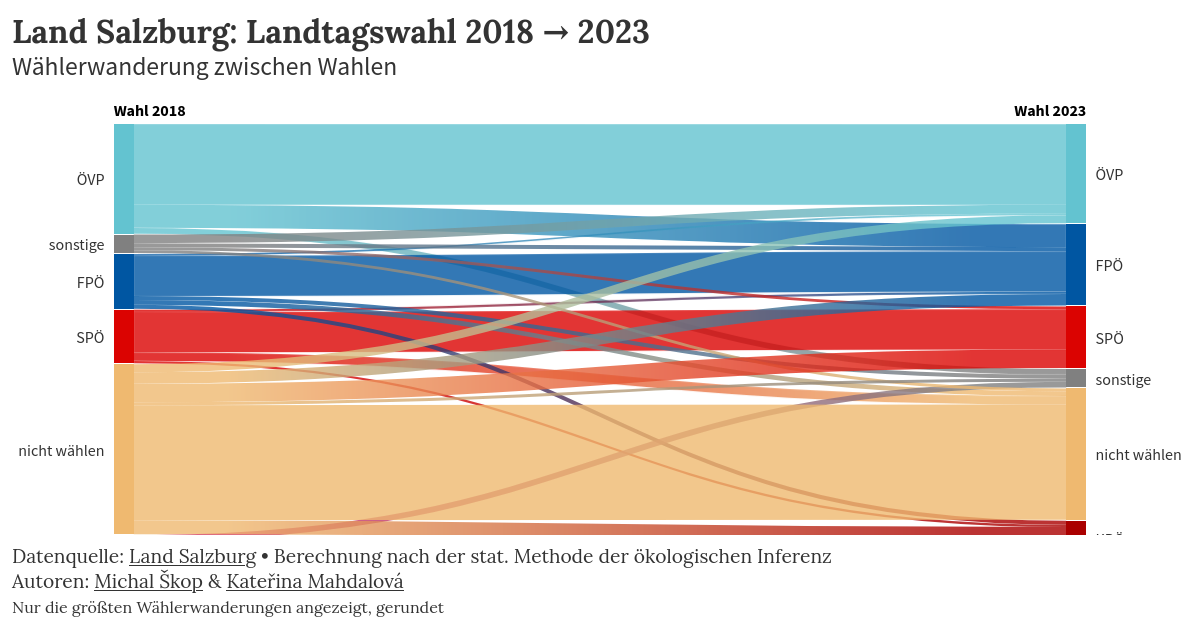
Turnout rose from 62.9% to 74.2%. According to Forschungsgruppe Wahlen, 37% of today's Die Linke voters did not vote in 2023, 27% already voted for Die Linke then, 14% for the Greens and 11% for the SPD. Five per cent voted for the CDU at the time. Infratest dimap estimates that the party gained roughly 75,000 votes from previous non-voters, 57,000 from the Greens and 39,000 from the SPD. There was almost no movement of voters between Die Linke and the AfD.
Die Linke therefore won by mobilising people who had previously stood aside and by drawing voters from the centre-left. It had been building support among the young for some time: in the federal election of February 2025, according to infratest dimap, 25% of voters aged 18–24 voted for it, compared with 8% four years earlier. In Berlin it came first at that time with 19.9%.
Radical, not extremist: how political scientists and the authorities classify the party
Die Linke is the legal successor of the SED, East Germany's ruling party. After the fall of the Wall the party renamed itself the PDS, and in 2007 it merged with the WASG, a grouping founded by former SPD members and trade unionists. Its 2011 Erfurt Programme, which is still in force, calls for "a change of system", because in its view capitalism is incompatible with the party's goals, and seeks to transfer large companies into "democratic forms of social ownership". The claim that the party wants to overcome capitalism is therefore true. The party frames this as "democratic socialism" and writes in its programme that it has "irrevocably broken with Stalinism as a system".
Political science distinguishes between radical and extremist parties. A radical party seeks profound change, but within democracy. An extremist party rejects democracy. The international PopuList database, compiled by a group of European political scientists including Cas Mudde, has listed Die Linke since 2007 only as a borderline case of the far left. It has classified the AfD unambiguously as far right since 2015. The Chapel Hill Expert Survey, in which experts rate the positions of European parties, shows this even more clearly. On the left–right axis, Die Linke is as far from the centre as the AfD. But on the questions that measure attitudes to democratic institutions, namely the independence of the courts and limits on executive power, it stands next to the SPD and the Greens. It is close to the AfD on only one item: its stance towards Russia.
The authorities assess the party in a similar way. The Federal Office for the Protection of the Constitution, Germany's domestic intelligence agency, does not monitor Die Linke as a whole. In its annual report for 2025 it mentions the party only in connection with the Trotskyist network marx21, which "operates in the party's milieu". Some state offices monitor its internal currents: for example, the office in Baden-Württemberg watches the Communist Platform and the youth organisation Linksjugend ['solid], while expressly adding that the party as a whole is not under observation. From May 2025 the federal office classified the AfD as "confirmed right-wing extremist", above all because of its ethnic conception of the nation, which in the office's view violates human dignity. In February the Administrative Court in Cologne provisionally barred it from using this label, so until a ruling on the merits the AfD is listed as a "suspected case" and the office may continue to monitor it.
Since 2018 the CDU has had a resolution ruling out coalitions with both parties. But it gives different reasons: it describes the AfD as anti-democratic and "fascistoid", while it faults Die Linke for being the successor to the SED, for its socialism, its position on NATO and its extremist currents. It states explicitly that it does not put the two parties on the same level.
After some twenty-five years in which Die Linke, and before it the PDS, shared power in Berlin, Brandenburg, Thuringia, Bremen and Mecklenburg-Western Pomerania, we found no evidence that they weakened the courts, media freedom or the rights of the opposition. In government the party tended to be more pragmatic than its programme promises. In 2004 Berlin's SPD–PDS Senate sold the municipal housing company GSW, with roughly 65,000 flats, to financial investors. When the Constitutional Court struck down Berlin's rent cap in 2021, the Senate with Die Linke respected the ruling.
Where the real risks lie
That does not mean the party is free of problems. The strongest and best-documented criticism is antisemitism in parts of the Berlin organisation. At a pre-election rally of the Neukölln branch on 29 August, the rapper Dahabflex performed with the slogans "Yalla Yalla Intifada" and "death to the IDF", the Israeli army, and the officials present did not intervene. The lead candidate, Elif Eralp, distanced herself, saying she was "appalled", but a spokesperson for the Neukölln branch told Jüdische Allgemeine that she stood "without reservation" behind the title of the song "Stop the genocide". The police are investigating the performance.
The problem is not new. In October 2024 five of the Berlin party's leading politicians left, among them the former culture senator Klaus Lederer, because, in their words, they had been unable to win a clear stance against antisemitism within the organisation. The party congress in Chemnitz in May 2025 adopted as its guideline the Jerusalem Declaration on Antisemitism instead of the IHRA definition used by most German institutions. The Jerusalem Declaration defines antisemitism more narrowly and, for example, does not consider support for a boycott of Israel antisemitic in itself. In June, Bavarian public broadcaster BR published posts from internal forums of the youth organisation Linksjugend ['solid], in which officials wrote "long live Stalin" and "long live Honecker", referred to Mao, wrote about "Israeli concentration camps" and shared an Israeli flag with the slogan "Israel, perish". According to ZDFheute, the party's co-leader Ines Schwerdtner responded that the party distanced itself from the content "in the strongest possible terms" and that anyone who saw things differently "has no place with us".
After the election, the Central Council of Jews in Germany called on the SPD and the Greens not to take Die Linke into government and described the party's assurances as "mere words". The party leadership, for its part, rejects support for Hamas. Co-leader Jan van Aken said in an interview with ARD in August last year that Hamas is "a fascist organisation" and "can never be a partner". The Berlin organisation expelled the activist Ramsis Kilani over his statements about the 7 October attack; the federal arbitration commission confirmed this in November 2025, and members in Neukölln occupied the party headquarters in protest. We found no report that anyone in the party leadership identifies with Che Guevara, as a Facebook post claimed.
The second risk is an unclear boundary with criminal and extremist milieus. Issa Remmo, the head of a well-known criminal clan, turned up at the election-night party in Neukölln. According to Eralp, he had not been invited and was asked to leave. According to published reports, the Bundestag member Ferat Koçak exchanged messages with Remmo's son and sent "respectful greetings" to his father. He called this a mistake and temporarily stepped back from his party roles. Eralp herself was a member until 2025 of Rote Hilfe, an association that supports left-wing activists facing prosecution and which Berlin's office for the protection of the constitution lists as non-violent left-wing extremist. According to t-online, she left the association "because of partly differing political views".
The third point of contention concerns the defence of democracy itself. Die Linke's Berlin programme wants to abolish the state office for the protection of the constitution as an intelligence service and replace it with an independent body without intelligence-gathering methods. According to the programme, the office "harms the democratic rule of law more than it protects it". Die Linke and the Greens have long justified similar proposals by the failures of the authorities in the case of the NSU, a neo-Nazi terrorist group. Critics object that the city would lose a tool against Islamists and the far right alike.
The fourth is foreign policy, where the Berlin government has little say. The Erfurt Programme calls for NATO to be dissolved and replaced by a collective security system "which also includes Russia". The manifesto for the 2025 federal election is milder: it wants to make NATO "superfluous", condemns the Russian attack on Ukraine and calls for targeted sanctions against Putin's power apparatus, but it rejects arms deliveries and wants to abolish the EU border agency Frontex. The wing most accommodating towards Moscow left in 2023 with Sahra Wagenknecht for the BSW party, which won 4.7% in Berlin. But defence and foreign policy are decided at federal level; a state government runs the police, schools, universities, municipal companies and housing.
That leaves expropriation. An expert commission set up by the Berlin Senate after the referendum and chaired by the former federal justice minister Herta Däubler-Gmelin of the SPD concluded in its 2023 final report that Berlin has the power to legislate for socialisation and that it is compatible with the constitution. A majority of the commission also accepted compensation below market value; three members disagreed. The risk is therefore legal and financial, involving court cases and compensation running into billions, not a breach of the constitution.
Why it sounds different in Czechia
In the Czech coverage we reviewed, Die Linke's communist origins come up more often than in foreign coverage. For readers who lived under the KSČ, the Communist Party of Czechoslovakia, that is understandable: the succession from the SED is real, and the party still struggles with it in Germany today. Most news reports mentioned housing as voters' main motive, from ČT24 and ČTK to Aktuálně, Seznam Zprávy and Deník. In headlines and commentary, however, two different things often blurred together: the fact that part of Die Linke tolerates antisemitism and has an unclear boundary with the extremist milieu, and the assumption that the party as a whole threatens the democratic order. The first is documented. The second is not supported by political scientists, the authorities or the party's record in government. The newspaper Deník captured the difference from the AfD when it described Die Linke as a threat, "but a different one from the brown AfD".
The debate also included a comparison with Prague: housing in Berlin is said to be similarly unaffordable, and yet young Czechs do not vote for the far left. In terms of prices relative to incomes, Prague is worse off. According to the Deloitte Property Index 2025, a 70-square-metre flat in Prague costs fifteen average gross annual salaries, which makes it the third least affordable capital in Europe. A Berlin flat of the same size works out, by our calculation from prices of flats sold in 2025 (€5,511 per square metre) and average annual earnings (€51,111), at roughly seven and a half salaries.
The difference lies in who feels the housing crisis. Czechia is a country of owners: according to Eurostat, 75% of people live in their own homes, compared with 47% in Germany as a whole. In Berlin only 15% of households live in their own homes. The typical Berlin voter is a renter who pays more and more and finds it hard to get a new lease. Moreover, according to the SIMAR post-election study, young Czechs in the 2025 parliamentary election mostly supported STAN (Mayors and Independents) and the Pirates. The list of the Stačilo! (Enough!) movement, on which communists from the KSČM also stood, won 4.3% nationwide and did not enter the Chamber of Deputies.
What comes next
A recount in one constituency in Spandau, where an AfD candidate won the direct seat instead of the CDU candidate, reduced the parliament from 158 to 153 seats according to the state returning officer, because balancing seats fell away. On this basis Die Linke has 45 seats, the CDU 33, the AfD 29, the Greens 25 and the SPD 21. The state election committee will announce the final result on 12 October. Die Linke, the SPD and the Greens would have 91 seats; a majority is 77. The alternative is a coalition of the CDU, SPD and Greens with 79 seats.
Representatives of Die Linke, the SPD and the Greens met for the first time on 1 October and, according to ZDFheute, parted after about five hours without a result. Further rounds of preliminary talks followed on 3 and 7 October. The SPD and the Greens are making the start of exploratory talks conditional on agreement on how to act against antisemitism and clan crime. Die Linke's parliamentary group therefore, according to taz, put forward an amendment to its rules under which an agreement on the exercise of their mandate would be binding on its members, including rejection of antisemitism and a ban on cooperation with people and organisations linked to Hamas. After the third round, according to the Tagesspiegel, an agreement was taking shape and the parties wanted to announce the result on 8 October. Expropriation, which the SPD's lead candidate Steffen Krach rejected during the campaign, also remains contentious. If the parties reach agreement, Elif Eralp would become Berlin's first Governing Mayor from Die Linke. According to Forschungsgruppe Wahlen, 36% of voters would like to see her in the post, and 29% the CDU candidate, Stefan Evers.
Young voters in Germany have been switching parties quickly in recent years. In 2021 they voted mainly for the Greens and the liberal FDP; according to infratest dimap, Die Linke then had 8% among voters aged 18–24. Four years later it had 25%, and in Berlin this year 43% in the 16–24 group. Whether the party keeps this support will depend on two things: whether it can deliver on its housing promises from a position in which it cannot change federal law, and whether it manages to deal with antisemitism in its own ranks before that makes it impossible for it to govern.