In Serbia's snap parliamentary election on Sunday, 1.73 million people voted for Aleksandar Vučić's list. Three years ago it was 1.78 million, only 57,000 more. Even so, Vučić's Serbian Progressive Party (SNS) is losing power after 14 years. The Student List, which grew out of the protests after the disaster in Novi Sad, received 2.35 million votes: 1.4 million more than the Serbia Against Violence coalition, the strongest opposition force in 2023, and more than all lists except Vučić's put together back then.
The outcome was therefore not decided by Vučić's voters walking away. What decided it was that 612,000 more people turned out, and that this time the votes against the ruling party came together on a single list. The other parties, which together received more than a million votes in 2023, did not reach even 300,000 this year.
The results come from the website of the Republic Electoral Commission (RIK) as of 7:20 on 29 October, when 8,338 of 8,392 polling stations had been counted. We calculate shares from valid votes. RIK gives them as shares of all ballots cast, including invalid ones, which is why they are slightly lower on its website (students 53.04%, Vučić's list 38.97%). Voting will be repeated at 53 polling stations on 1 November. The seat allocation is our own calculation; RIK will announce it only after the final results. We updated the text on 29 October.
The same share of Serbia voted for Vučić as three years ago
Of all registered voters, slightly more than a quarter gave their vote to Vučić's list this year: 26.9%. In 2023 it was 27.4%. The comparison comes with one caveat: this year Vučić's list also included Vojislav Šešelj's Radicals, who ran separately three years ago and received 55,782 votes. Adding them in, Vučić's camp lost 113,000 votes, or six per cent.
Its share of valid votes, however, fell from 48.1% to 39.5%. Turnout explains the gap between the stable number of votes and the drop in share. In 2023, 58.8% of registered voters went to the polls; this year, 69%. There were 663,000 more valid votes, and Vučić's list gained none of them overall.
The Student List received 53.7% of valid votes and, by our calculation, 141 of the 250 seats. A governing majority requires 126. Ivica Dačić's Socialist Party of Serbia fell from 250,000 votes to 95,000 and, with 2.2%, did not make it into parliament. Of the other lists, only minority lists, which do not have to clear the three per cent threshold, entered parliament: the Alliance of Vojvodina Hungarians, the Albanian Coalition, Rasim Ljajić's list and SDA Sandžak.
The overall figures do not reveal who exactly voted for whom. That the students won the votes of new voters, of traditional opposition voters, of nationalist lists, or even of some of Vučić's voters, whom SNS replaced with others, is possible in any combination. The national totals show only that Vučić's list held its ground in number of votes and that everything that was added to the turnout or lost elsewhere ended up with the students.
Unlike in 2023, the opposition did not split this year. The Narodna Srbija (People's Serbia) coalition, which included Miroslav Aleksić's People's Movement of Serbia, withdrew its list on 22 September in favour of the students. European Serbia of Marinika Tepić and Zdravko Ponoš, a coalition around Dragan Đilas's Party of Freedom and Justice, ran on its own. It received 12,562 votes, 0.3%.
Vučić’s list won almost as many votes as in 2023. The students won 1.4 million more than the main opposition did then
Votes in the 2023 and 2026 parliamentary elections by group of lists, and registered voters who did not vote
2023 (lighter bar)2026
The Serbian Radical Party ran on its own in 2023 and on Vučić’s list this year. Figures for 2026 reflect the count as of 07:20 on 29 October (8,338 of 8,392 polling stations). “Did not vote” = registered voters at counted polling stations who did not cast a ballot.
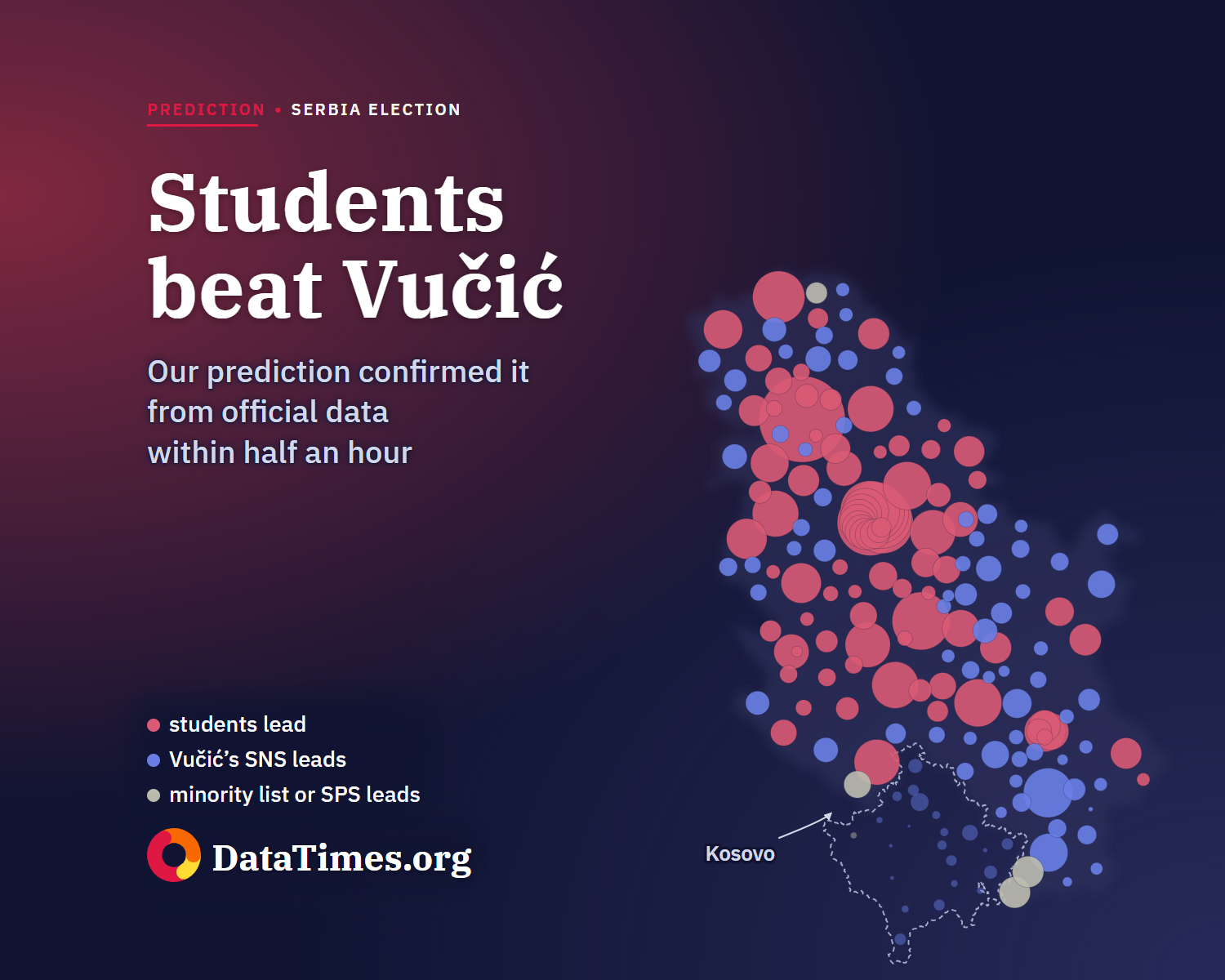
The students won the cities, Vučić small municipalities in the south and voters from Kosovo
According to our prediction, the students lead in all 17 Belgrade districts, from 48% in Sopot to 74% in Stari Grad. They won in every municipality and city district with more than a hundred thousand registered voters except Leskovac: in Novi Sad with 64%, in Kragujevac with 59%, in Pančevo, Subotica and Kruševac. Among Serbs abroad they received 73%.
Vučić's list leads in 95 of the 191 municipalities and city districts for which RIK reports results, the students in 91. But the municipalities where the students lead have 4.96 million registered voters, those dominated by SNS 1.35 million. Of the 76 municipalities outside Belgrade and Kosovo with fewer than 20,000 voters, SNS won 53. In the south and east of Serbia it leads in 37 of 52 municipalities.
The 191 units for which RIK reports results include 22 municipalities of Kosovo. Serbia does not recognise the independence Kosovo declared in 2008, and people registered on Serbian electoral rolls in Kosovo municipalities can also vote for the Serbian parliament. Kosovo, whose independence is recognised by the Czech Republic and most other EU member states, did not allow the election to be held on its territory. For roughly 100,000 such voters, RIK therefore set up 60 polling stations in Vranje, Raška, Kuršumlija and Tutin in southern Serbia and reports the votes by the municipality where the voters are registered. About a third of them cast a valid vote, and Vučić's list won in 21 of the 22 Kosovo municipalities; in Peć the Socialists led.
A year and a half of protests after the disaster in Novi Sad
The student movement emerged after 1 November 2024, when a concrete canopy collapsed at the railway station in Novi Sad and killed 16 people. The station had recently been renovated. Students began blockading their faculties, demanding the publication of the documents on the renovation and the punishment of those responsible. The largest demonstration took place in Belgrade on 15 March 2025. The Arhiv javnih skupova (Archive of Public Gatherings) initiative counted 275,000 to 325,000 people, the police 107,000.
The protests cost Prime Minister Miloš Vučević his post; he resigned on 28 January 2025. He was succeeded in April by Đuro Macut. From May 2025 the students demanded a snap election. Vučić called it on 9 September 2026 for 25 October, with the shortest possible campaign of 45 days.
On 27 September Vučić himself stepped down as president, eight months before the end of his second term. He cannot be president a third time; the constitution allows only two terms. He led the Ujedinjena Srbija (United Serbia) list into the election as its candidate for prime minister. He said he wanted to compete "as an ordinary man, as a man of the people, against those who are against the people". Since 28 September, the presidential powers have been exercised by the speaker of parliament, Ana Brnabić.
The Student List has no single leader. It is headed by the physician Ilija Srdanović, a professor at the Faculty of Medicine of the University of Novi Sad, and is made up mainly of experts and university teachers selected by the students. It has not yet announced a candidate for prime minister.
Polls did not expect such a large victory
Pre-election polls diverged depending on who conducted them. In June, the organisation CRTA, together with a Stanford University lab, measured 44.9% for the students and 35.7% for Vučić's party. The agency Faktor plus, by contrast, found 48.6% for SNS and 37.1% for the students in September. No poll we could find measured a fourteen-point lead for the students.
Observers: high turnout, uneven campaign
International observers from the OSCE, the Parliamentary Assembly of the Council of Europe and the European Parliament praised the high turnout and the genuine competition between the two main contenders in their preliminary statement. But in their view, equal opportunities in the campaign were "seriously undermined". According to the observers, the ruling party benefited from a "significant misuse of public resources", public and private media favoured Vučić's list and portrayed the Student List mostly negatively. The observers also recorded physical attacks on members of election commissions, observers and journalists. They assessed election day positively in the vast majority of polling stations they visited, but had reservations about the transparency of the count.
What comes next
RIK will announce the final results after the repeat vote at 53 polling stations on 1 November. By our calculation, a few thousand votes will decide the last seat, but not the students' majority. Under the constitution, the new parliament must convene no later than 30 days after the final results are announced. The candidate for prime minister is nominated by the president, which now means acting president Brnabić from Vučić's party. If parliament fails to elect a government within 90 days of its constitution, it is dissolved.
Serbia also faces a presidential election before the end of this year. The speaker of parliament may stand in for the president for no more than three months, so the election must take place by the end of the year. Vučić may not run. Whether his party will at least keep the presidency will be decided by the same voters who sent it into opposition on Sunday.
How election night unfolded and how quickly our prediction confirmed the students' victory, we describe in the article on the prediction.