Benjamin Netanyahu and his allies lost their majority in the Knesset, Israel's single-chamber parliament of 120 members, in the election of 27 October 2026. According to preliminary results from the Central Elections Committee, the five parties of his outgoing coalition hold 53 of the 120 seats between them, eleven fewer than in 2022. But the opposition led by former military chief of staff Gadi Eisenkot has no majority either: the four parties of its bloc won 48 seats.
The remaining 19 seats went to two Arab parties, the Joint List and Ra'am. Arab parties have never held so many seats in the Israeli parliament; the previous record was 15 in 2020. Neither bloc can form a majority without them. Yet most Jewish parties refuse to govern with them.
The figures are still preliminary. By Thursday the committee was counting more than half a million so-called double envelopes, used by soldiers, diplomats and people in hospital to vote, and it will announce the final results by 4 November. One or two seats may still shift, and one has already moved between the Arab parties. That should not change the fact that no bloc has a majority: Netanyahu is eight seats short, Eisenkot thirteen.
Both roads to government stop at sixty votes
A majority requires 61 members. Eisenkot's bloc – his party Yashar (21 seats), Beyachad (Together) led by Naftali Bennett and Yair Lapid (12), Yair Golan's Democrats (8) and Avigdor Liberman's Yisrael Beytenu (7) – would have 67 votes together with both Arab parties. But Liberman refuses to work with the Arab parties, and Eisenkot promises a government resting on a "Zionist majority". Without Liberman and with the Arab parties, the opposition has 60 votes.
Netanyahu is eight votes short. If Liberman, who served as his defence minister in 2016–2018, crossed over to his bloc, he too would have 60. Mathematically, winning over Bennett would be enough, giving him 65 votes, but the opposition parties have ruled out joining a government under Netanyahu. A grand coalition of the two largest parties, Likud (26) and Yashar (21), would add up to 47 votes, and Eisenkot also refuses to serve under Netanyahu, even in a rotation government.
Our own conversion of official votes into seats applies the electoral threshold of 3.25% of valid votes, the D'Hondt method, which Israel calls the Bader-Ofer method, and the parties' surplus-vote agreements. For the election-night results, the calculation matched the seat distribution published by the media.
Some 5.2% of valid votes, more than a quarter of a million, went to parties below the threshold. The closest were the reservists' party of Yoaz Hendel and Yaron Zelekha with 2.64% and the party of former general Ofer Winter with 1.61%.
Arab parties have the most seats in their history
According to Israel's Central Bureau of Statistics, Arabs make up 21% of the population but only 18% of voters living in the country, because they are younger on average and some of them, particularly residents of East Jerusalem, do not hold Israeli citizenship. Even so, Arab parties have long held between eight and fifteen seats in the Knesset, because Arab voters turned out less than Jewish voters. In Arab and Druze localities, turnout fell to 44.6% in 2021, while 67.4% of eligible voters cast a ballot nationwide, according to a data series compiled by Arik Rudnitzky of Tel Aviv University.
This year the picture is different. The Joint List, made up of the Arab-Jewish party Hadash, Ahmad Tibi's Ta'al and the nationalist Balad, won 9.2% of the vote and 11 seats. Mansour Abbas's Islamist Ra'am, which ran on its own, has 6.1% and 8 seats. In the results of 28 October the split was still 12 to 7. The two parties have a surplus-vote agreement, and fewer than 500 votes now decide which of them gets the nineteenth seat. Our prediction (in Czech), which projects the remaining envelopes, expects a return to 12 to 7. The Joint List alone won more votes than Bennett and Lapid's Beyachad.
Turnout was different this time. In 111 Arab localities and among voters of 20 Bedouin tribes in the Negev, 80% of registered voters went to the polls, according to the results by locality from the Central Elections Committee. Adding Druze localities, as Rudnitzky's series does, gives 78%. The same calculation for the 2022 election results gives 53%. In Arab localities, the Arab parties received 64% more votes than four years ago: 689,000 instead of 420,000. Localities are classified using the Central Bureau of Statistics register, not by how they voted.
Arab localities voted for the Arab parties almost as one: the Joint List took 56% of the vote there and Ra'am 37%. Ra'am holds the Bedouin south, winning 85% in Rahat, the largest Bedouin city. The Joint List leads in the north, with 90% in Umm al-Fahm. Arab-majority localities gave the two Arab parties 87% of all their votes. Mixed cities supplied most of the rest. In Acre, where Arabs make up a third of the population, the Arab parties won 35% of the vote; in Lod, 25%.
The Druze vote differently. In the fifteen Druze-majority localities, the Arab parties won 7% of the vote combined. The strongest party there was Eisenkot's Yashar with 38%, followed by Liberman's Yisrael Beytenu with 25%. Unlike other Arabs, Druze men serve in the army, and Druze localities have long voted for Zionist parties.
In Jewish localities, 72% of voters went to the polls. This figure cannot yet be compared with Arab localities, however. It does not include the double envelopes, mainly soldiers' votes. These come predominantly from Jewish localities, and the committee does not assign them to localities but records them separately. By the morning of 29 October it had counted 29,000 of them; in 2022 there were 463,000. Nationwide, 71.3% of eligible voters have cast a ballot so far. In Israel, the number of eligible voters also includes citizens living abroad who cannot vote, so actual turnout among people in the country is higher.
Some overlap between the two worlds remains. Some Arab voters vote for Zionist parties and a small share of Jewish voters back Hadash. But the American-Israeli public opinion expert Dahlia Scheindlin said in a report by Deník N (in Czech), a Czech daily, that in recent years Arab votes have gone overwhelmingly to Arab parties and Jewish votes to Jewish ones.
Arab voters turned out because of crime and Ben Gvir
Why they turned out this time is described in a pre-election report from Haifa by Dominika Píhová for Deník N (in Czech). The people she spoke to do not talk about hopes of changing Israeli policy. They see voting as self-defence: against organised crime in Arab towns and against a government in which the police are the responsibility of National Security Minister Itamar Ben Gvir. Sally Abed, a Haifa city councillor from the Arab-Jewish movement Standing Together, described the right to vote as "the only equal right we de facto have".
The numbers bear them out. According to the Abraham Initiatives, more than a hundred Arab citizens of Israel were killed in violent crime in 2022, 244 in 2023 and 252 in 2025, the highest since the organisation's records began. This year at least 185 had been killed by mid-October. According to the same organisation, the police solve roughly one in ten of these murders. The Knesset Research and Information Center calculated for the State Control Committee that in 2025, 1,874 people were hospitalised or died as a result of criminal violence; roughly two-thirds of them were Arabs, and among those shot, 90%.
Netanyahu campaigned under the slogan "Right or Palestine", Ynet reported. His bloc lost eleven seats compared with 2022. Likud fell from 32 to 26 seats and the ultra-Orthodox Shas from 11 to 7. Ben Gvir's Otzma Yehudit, which ran jointly with Smotrich's Religious Zionism in 2022, has seven seats on its own.
Polls expected Eisenkot to lead
The final polls of the three main television channels, on Friday 23 October, had Eisenkot's Yashar as the largest party with 22 to 23 seats and Likud second with 19 to 21. They gave Eisenkot's bloc 52 to 56 seats and Netanyahu's 50, Haaretz summarised. The result was the reverse. Likud has 26 seats and Netanyahu's bloc leads by five. The polls gave the Arab parties 14 to 16 seats; they won 19.
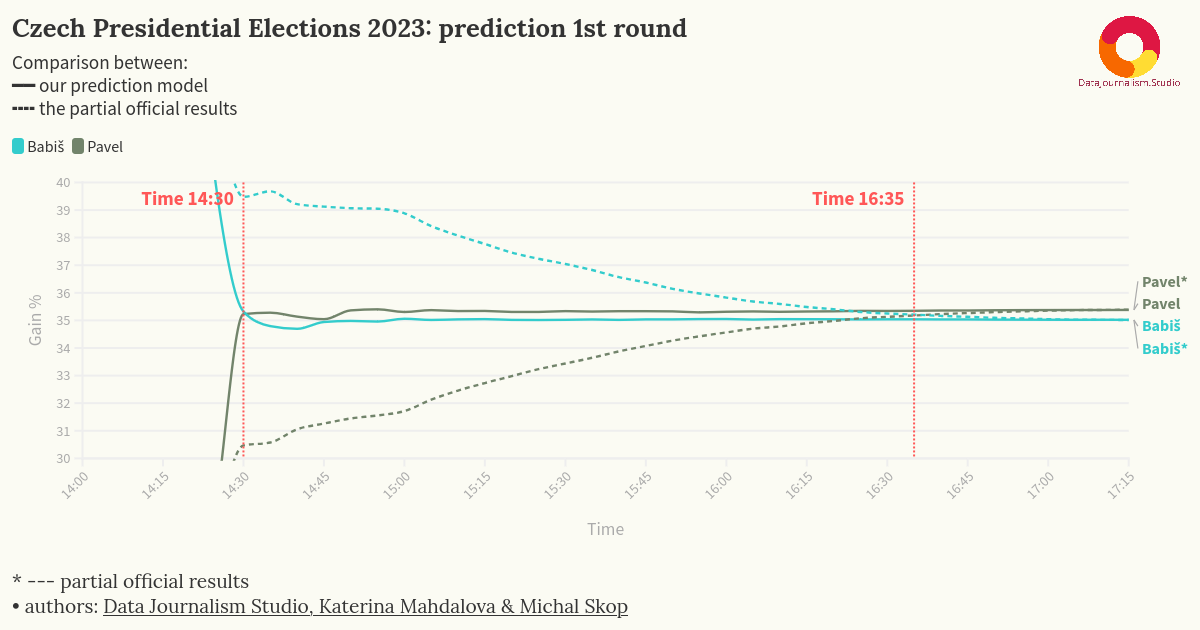
From the first hour of counting, our prediction showed that no bloc would win a majority. We describe how election night unfolded and our estimate of the final result in the article on the prediction (in Czech).
Ra'am wants to join the government, the Joint List only to support it from outside
The Arab parties are not a single bloc. Mansour Abbas has already shown once that he can strike a deal with the right. In June 2021 Ra'am became the first independent Arab party in an Israeli coalition, giving the government of Naftali Bennett and Yair Lapid its 61-vote majority and in return negotiating an investment plan for Arab localities worth 30 billion shekels and funding to fight crime. Abbas was not a minister; he chaired a special Knesset committee on Arab society affairs. The government lasted a year and collapsed in June 2022, partly over a dispute about extending the regulations that apply Israeli law to settlers in the occupied West Bank.
This year Abbas is trying to convince Jewish voters and parties that he is someone they can govern with. In second place on his list he put Yoav Segalovitz, a former head of the police investigations division and Yesh Atid lawmaker, the first Jew on Ra'am's slate.
The Joint List, led by Hadash chair Yousef Jabareen, does not want to join the government. It offers the opposition support in removing Netanyahu, but without a seat in the cabinet. There is a precedent: in 1992–1995, two Arab parties with five members supported Yitzhak Rabin's minority government from outside, and thanks to them the government survived even the departure of Shas. Under Rabin, Israel signed the Oslo Accords.
A minority government with Arab support from outside is now the most feasible way for the opposition to reach 61 votes. But it runs up against Eisenkot's Jewish partners, who refuse to rely on Arab votes.
Another election as early as spring if the parties cannot agree
President Isaac Herzog will receive the final results next week from the chair of the elections committee, Supreme Court Justice Noam Sohlberg. He will then ask every party that entered the Knesset whom they recommend for prime minister, and task the candidate with the best chance of securing 61 votes with forming a government. That candidate has 28 days, with a possible extension of 14. If they fail, the president can task another candidate, and finally the Knesset has 21 days. If no majority is found even then, parliament is dissolved and a new election is held within 90 days. Until then, Netanyahu governs as caretaker prime minister.
The day after the election, Herzog called on the parties to come to the consultations "with an open mind" and to do everything they could to avoid another election, the Times of Israel reported. Israel voted five times between 2019 and 2022.
The number of Arab lawmakers now matters more than ever before. Whether their votes turn into influence will be decided by the Jewish parties: whether they accept the support that Ra'am and the Joint List are offering, or go back to the polls in a few months with the same arithmetic.
How we calculated
The seat calculation is based on the votes published by the Central Elections Committee for the 26th Knesset (as of 7:37 on 29 October 2026, with 11,920 polling stations counted and 29,000 double-envelope votes so far). Turnout and votes by locality come from the committee's results by locality for 2026 and 2022. The classification of localities as Jewish, Arab, Bedouin tribes in the Negev and mixed cities is based on the Central Bureau of Statistics register; the fifteen Druze-majority localities form a separate group. Turnout in localities does not include double envelopes, because the committee does not assign them to localities. Netanyahu's bloc consists of Likud, Shas, United Torah Judaism, Otzma Yehudit and Religious Zionism; Eisenkot's bloc of Yashar, Beyachad, the Democrats and Yisrael Beytenu.